

Why Automated Test Equipment (ATE) Is Important for Every OEM?
In today’s competitive manufacturing environment, OEMs (Original Equipment Manufacturers) are under constant pressure to deliver high-quality, reliable, and cost-effective products in less time. Manual testing methods are no longer sufficient to meet modern production demands.
This is where Automated Test Equipment (ATE) plays a critical role. ATE enables OEMs to test products faster, more accurately, and consistently ensuring compliance with quality standards while reducing production costs.
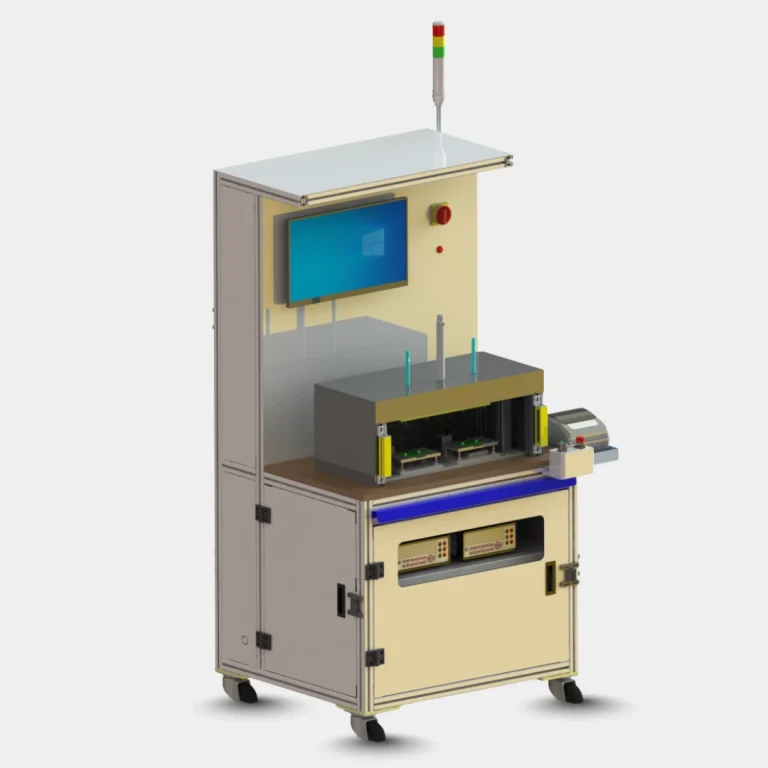
Why are leading OEMs shifting from manual testing to Automated Test Equipment?
Read more to know why ATE has become a must-have for modern manufacturing.
A) Ensuring Consistent Product Quality
One of the biggest challenges for OEMs is maintaining uniform quality across high-volume production. Manual testing depends heavily on operator skill, which can lead to variations and human error. Automated Test Equipment eliminates this inconsistency by executing predefined test sequences in exactly the same way for every product.
By using ATE, OEMs can ensure that each unit meets the same quality benchmarks, improving product reliability and customer confidence.
B) Faster Production and Reduced Cycle Time
Production efficiency is directly linked to testing speed. Automated Test Equipment significantly reduces test cycle time by performing multiple measurements and functional checks simultaneously. Unlike manual testing, ATE operates continuously without fatigue, making it ideal for mass production environments.
This faster testing capability enables OEMs to increase throughput and meet tight delivery schedules without compromising on quality.
C) Cost Reduction Over the Product Lifecycle
Although the initial investment in Automated Test Equipment may appear high, it delivers substantial long-term cost benefits. By reducing dependency on manual labor and minimizing rework, scrap, and field failures, ATE lowers the overall cost per unit.
In addition, early detection of defects during production helps OEMs avoid expensive warranty claims and service issues after product deployment.
D) Critical Role in End-of-Line (EOL) Testing
End-of-Line testing is the final quality gate before a product reaches the customer. Automated Test Equipment ensures that every finished product is thoroughly tested for functionality, safety, and performance before dispatch.
ATE systems can validate electrical parameters, communication protocols, and system behavior under predefined conditions, ensuring that only fully compliant products leave the factory.
E) Data-Driven Quality and Traceability
In modern OEM manufacturing, quality is no longer judged only bypass or fail results. OEMs need data-backed insights to understand why failures occur, where variations arise, and how processes can be improved. Automated Test Equipment (ATE) plays a crucial role in enabling this data-driven approach. ATE systems automatically capture detailed test data for every unit tested. This includes electrical parameters, functional results, timing information, communication logs, and environmental conditions. Unlike manual testing, this data is recorded accurately and consistently, forming a reliable foundation for quality analysis.
Key advantages of data-driven quality using ATE include:
- Early detection of trends and drifts: Continuous data collection helps OEMs identify parameter drifts, component degradation, or process instability before they lead to large-scale failures.
Root cause analysis: When failures occur, historical test data allows engineers to trace back the issue to specific components, test steps, or production batches, reducing troubleshooting time.
Process optimization: By analyzing pass/fail ratios and parameter distributions, OEMs can refine test limits, improve assembly processes, and enhance overall production efficiency.
F) Meeting Industry Standards and Compliance Requirements
OEMs often operate under strict regulatory and customer-specific standards. Automated Test Equipment helps ensure compliance by enforcing standardized test procedures and generating audit-ready reports. By using ATE, OEMs can confidently meet certification requirements and demonstrate product compliance during inspections and audits.
G) Scalability for Future Growth
As OEMs expand their product lines or introduce new variants, testing requirements evolve. Automated Test Equipment is designed to be modular and scalable, allowing easy updates to test sequences, hardware, and software.
This flexibility ensures that OEMs can adapt to future product changes without redesigning the entire test setup.
H) Conclusion
Automated Test Equipment plays a vital role in helping OEMs deliver high-quality products efficiently and reliably. By improving consistency, reducing costs, enabling data-driven decisions, and supporting regulatory compliance, ATE strengthens an OEM’s manufacturing ecosystem.
For any OEM aiming to stay competitive in modern manufacturing, investing in Automated Test Equipment is a strategic necessity—not just a technological upgrade.
